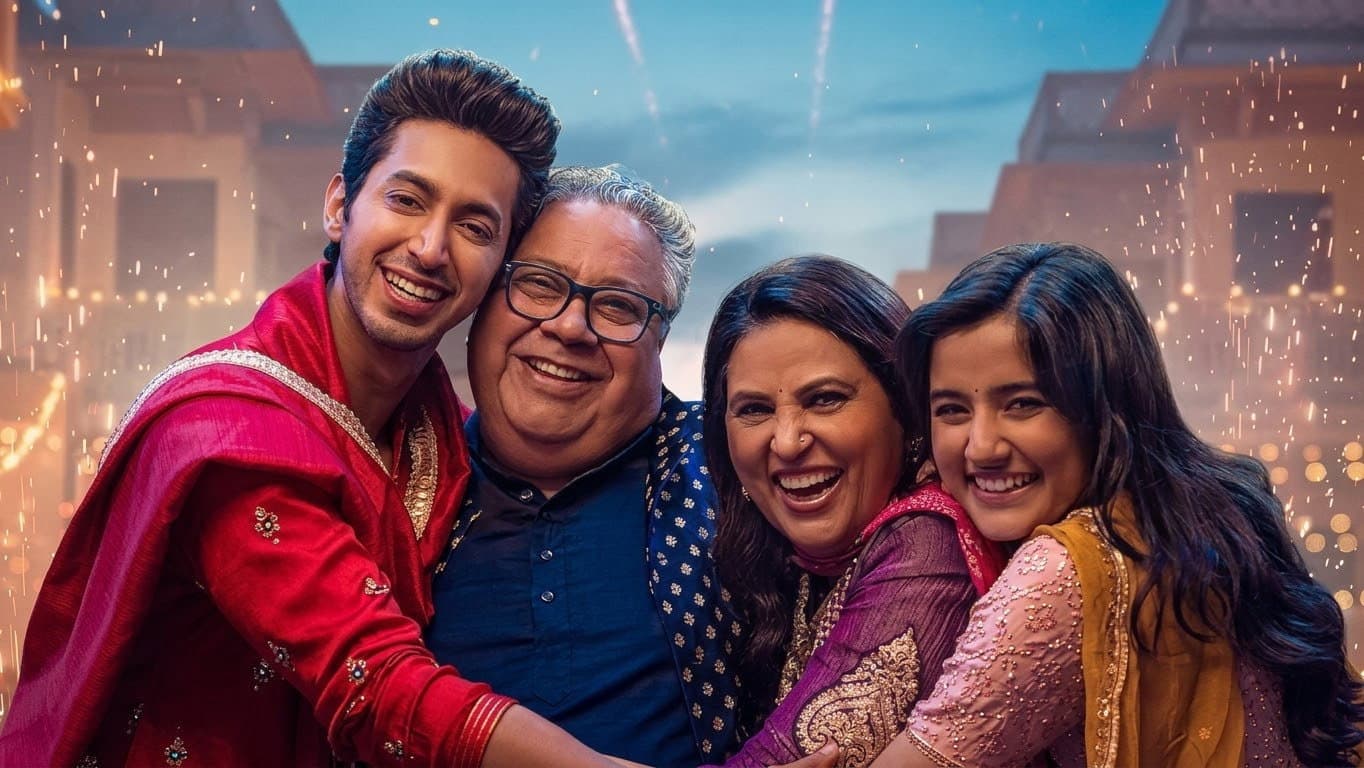
The lights are strung, the diyas are ready, and the mithai boxes have been carefully rationed. But in Ritesh Menon's new comedy Dilwali Diwali, the real fireworks are set off by the Sikka family itself. Released on November 5, 2026, this brisk sixty-one-minute film wastes no time in getting to the heart of a very familiar holiday dilemma: what happens when the people you love have wildly different ideas about how you should be living your life?
At the centre of the story is Ansh Sikka, played with an easy, slightly world-weary charm by Mihir Ahuja. Ansh has spent years working abroad, and he returns to his Punjabi family home for Diwali carrying more than just gifts and duty-free chocolates. He carries a set of assumptions his family no longer quite recognises. The Sikkas are gathering for the festival as they always do, but this year the rituals feel less like tradition and more like a series of gentle interrogations.
Manoj Pahwa and Neelu Kohli anchor the film as Sudhir and Sukhmani Sikka, the parents who built the household around certain certainties. Sudhir measures success in stability, in roots put down deep, in a son who stays close enough to be called upon. Sukhmani, meanwhile, runs the home with a warmth that often conceals her own quietly held expectations. Watching the two of them navigate Ansh's return is where Menon's film finds its richest comic ground. The tension never explodes into melodrama. It simmers, the way real family disagreements do, over cups of chai and half-finished sentences.
Aura Bhatnagar Badoni brings a sharp, lively energy as Mahi Sikka, the younger family member whose perspective cuts through the adults' circular arguments. She is the one who asks the questions nobody else wants to voice, and Badoni plays her with a comic timing that lands without straining. Manmeet Singh Sawhney rounds out the ensemble in a role that adds another layer to the family dynamic, and the cast as a whole settles into the rhythms of a household that has known each other far too long to be polite.
What makes Dilwali Diwali work, at least as a piece of storytelling, is its refusal to turn anyone into a villain. Ansh's desire for a life beyond the family home is not treated as betrayal. Sudhir's longing for proximity is not dismissed as smothering. The film sits in the messy middle, where everyone has a point and nobody has the full picture. Menon, working from a script that favours small observations over big declarations, keeps the comedy rooted in recognisable behaviour: the passive-aggressive remark disguised as concern, the mother who insists on feeding you through an argument, the father who brings up a decade-old grievance as if it were yesterday's news.
At a lean sixty-one minutes, the film is refreshingly economical. There is no padding here, no subplot wheeled in to fill time. Every scene moves the family a little closer to understanding one another, or a little further apart. The Diwali setting is not incidental. The festival of lights, with its emphasis on homecoming and renewal, provides a natural backdrop for a story about people trying to see each other clearly, even when the light is flickering.
The film has landed well with audiences, holding a TMDb rating of 7.5 out of 10 at the time of writing, which suggests that the Sikkas' particular brand of chaos has found a receptive audience. It is easy to see why. This is a Hindi comedy about a Punjabi family, and it wears that identity comfortably, but the questions it raises about ambition, duty, and the definition of a life well lived travel well beyond any single household.
In an industry that often equates family drama with volume, Dilwali Diwali chooses a different register. It is a comedy of manners set around a festival table, and its pleasures are the quiet ones: a well-timed pause, a glance exchanged across a room, the moment a character realises they have said exactly the wrong thing. Menon trusts his cast to carry the weight, and they do. Ahuja's Ansh is a young man learning that coming home is not the same as fitting in, and Pahwa and Kohli give the film its emotional centre without ever overplaying their hand.
For anyone who has ever sat through a festive meal while a silent argument played out beneath the small talk, Dilwali Diwali will feel less like a film and more like a memory. It is a small, warm, sharply observed comedy about the people who know us best and understand us least, and the annual ritual of trying, once again, to bridge that gap.