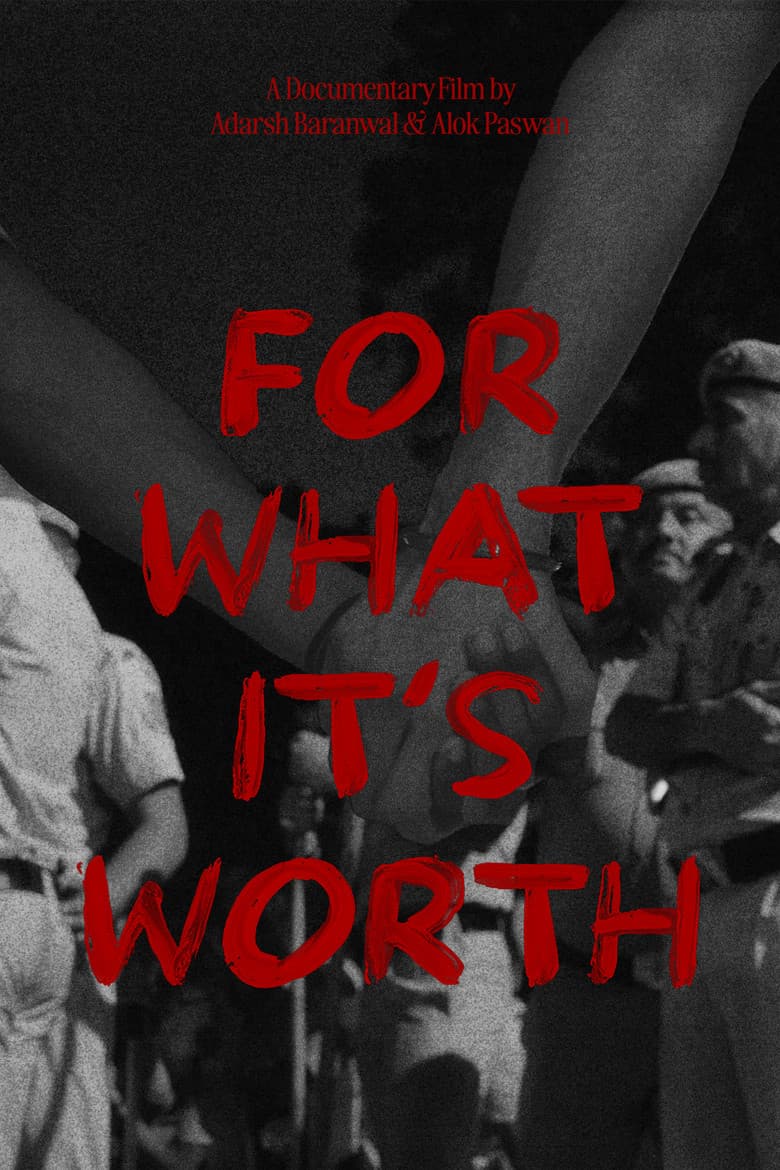
The most dangerous thing about a protest, once the tear gas settles and the news cycles move on, is how quickly it gets flattened into a hashtag. A chant becomes a caption, a demand becomes a debate between two panels, and the actual human beings who stood in the sun for days get reduced to props in someone else's argument. Adarsh Baranwal's new documentary, For What It's Worth, arrives with a title that sounds like a sigh of resignation, but the film itself is anything but resigned.
Clocking in at a lean 35 minutes, this Hindi-language documentary dropped on August 15, 2026, slipping into the Independence Day slate almost quietly, which feels appropriate for a film that is less about spectacle and more about listening. The premise is deceptively simple. Following the violence that broke out on July 20, two filmmakers - Baranwal and his unnamed collaborator - went to Jantar Mantar, that storied patch of Delhi asphalt where dissent has been staging itself for decades, and simply talked to the people still standing there. No narrator telling you what to think. No slow-motion drone shots of the capital's skyline to make it feel important. Just a camera, a microphone, and an endless supply of patience.
That patience is the film's real subject. The title For What It's Worth is a phrase you use when you're not sure anyone is listening - when you've said your piece so many times that you're no longer sure the words mean anything to anyone but you. And that's precisely the register Baranwal captures. The people at Jantar Mantar aren't delivering speeches. They're explaining themselves, over and over, to someone who has finally agreed to sit down and ask.
What makes the documentary interesting, and occasionally frustrating in the way the best docs are, is that it refuses to become a primer. If you come in expecting a tidy timeline - here's what happened on the 20th, here's who did what, here's the government's response - you'll leave unsatisfied. Baranwal isn't interested in the forensic version. He's interested in the aftermath version, the one where you have to figure out what a movement is once the cameras have left and the only people still around are the ones who genuinely believed in it.
The film's runtime is both its greatest strength and its only real limitation. At 35 minutes, there's no room for fat, no self-indulgent detours, and the result is a documentary that moves with the urgency of a dispatch rather than the leisure of a retrospective. But it also means some voices get less space than they deserve. You get the sense that Baranwal shot hours and hours of footage, and that the hardest work here was in the editing room, where entire conversations had to be sacrificed to keep the thing moving. There's a version of this film that runs two hours and lets every single person finish their thought. That version doesn't exist, and you feel the absence of it.
Technically, the film is unshowy in the best way. It has the grainy, handheld intimacy of something shot on the ground, in the crowd, without permits or pretension. The sound design leans into the ambient noise of the location - the hum of traffic, the distant slogans, the occasional crackle of a loudspeaker - so that you never forget where you are. Jantar Mantar becomes a character in its own right, a place that has absorbed so much anger and hope over the years that it practically hums with it.
It should be noted that the film has no rating to speak of yet - TMDb currently lists it at 0/10, which is less a verdict than an acknowledgment that almost nobody has seen it. That's a shame, because For What It's Worth is exactly the kind of documentary that Hindi cinema needs more of right now: small, specific, allergic to easy answers. It doesn't tell you what to feel about the protests. It doesn't tell you who was right or wrong on July 20. It just asks you to sit with the people who were there and hear them out.
In an era where every political event gets chewed up and spat out by the content machine within 48 hours, a film that slows down and asks "what was this actually about?" feels almost radical. Baranwal doesn't pretend to have the answer. He just refuses to let the question go unanswered. And for what it's worth, that's more than most films are willing to do.